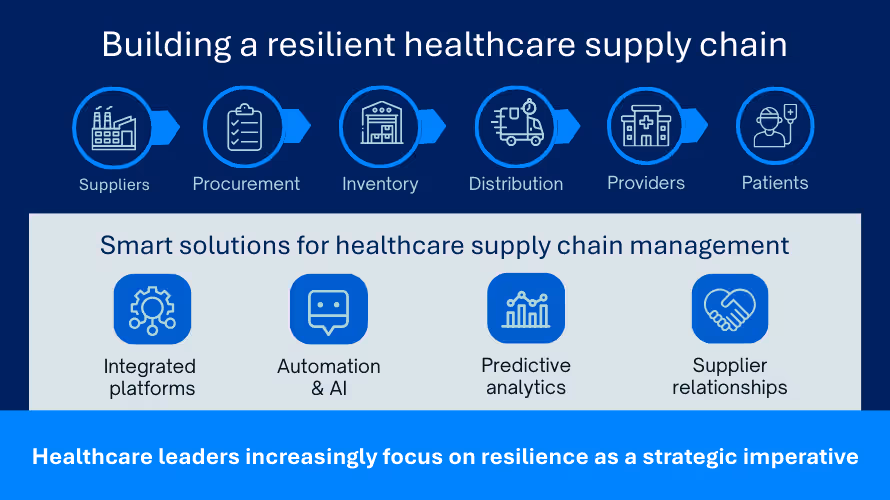
Healthcare supply chain management (SCM) is essential for ensuring medical products, supplies, and inventory reach the right place at the right time. In the wake of pandemic-era disruptions, healthcare leaders increasingly recognize supply chain resilience as a strategic priority. As a result, stronger logistics coordination and inventory control have become central to maintaining stable operations. Healthcare supply chains manage everything from everyday consumables to high-value devices and pharmaceuticals. A well-managed supply chain directly impacts patient outcomes, clinical efficiency, and costs. Modern SCM strategies and software are vital for reducing risk, improving efficiency, and maximizing savings amid rising expenses, lower reimbursements, and ongoing disruptions.
What is healthcare supply chain management?
Healthcare supply chain management encompasses the design, planning, execution, and oversight of the procurement, storage, and distribution of healthcare inventory and raw materials. Moreover, it involves supplier relationships, inventory management, custody tracking, recall management, and systems that provide real-time visibility into inventory levels, usage, and supply chain operations.
A complex healthcare supply chain must support:
- A large network of products and medical supplies
- High-quality care standards and strict regulatory compliance
- Specialized workflows where supply chain issues can directly affect patient outcomes
Healthcare supply chains are generally more fragmented and complex than other sectors. For example, a problem with a supplier several tiers down the chain can suddenly affect many organizations and patients. According to the Department of Health and Human Services (HHS), 89% of hospitals reported shortages of critical supplies during the COVID-19 pandemic, exposing major vulnerabilities in the global supply system. Effective supply chain management is a powerful means of achieving lower costs and maintaining high-quality care in healthcare organizations.
Why healthcare supply chain management matters
Efficient supply chain operations enable healthcare organizations to:
- Ensure timely delivery of medical products and prevent shortages that could compromise patient care
- Reduce costs through improved inventory accuracy and more strategic purchasing
- Increase efficiency by minimizing manual processes and errors
- Strengthen resilience against supply disruptions
- Support better decision-making through real-time tracking and advanced analytics
Supply chain expenses can account for roughly one-third of a hospital’s operating budget, making operational efficiency a strategic priority. This financial pressure reinforces the need for stronger automation and system alignment. A well-managed supply chain allows leadership to monitor inventory levels, supplier performance, and potential risks more effectively, while freeing clinicians to focus on patient care.
Common supply chain challenges in healthcare
Many healthcare organizations face persistent supply chain issues, including:
- Limited visibility: Fragmented systems prevent real-time tracking of inventory information, usage, and supplier performance across health systems
- Regulatory and compliance complexity: Strict regulatory compliance adds layers of operational processes and risk. For this reason, SCM software should maintain audit trails for FDA and HIPAA standards
- Inventory waste and stockouts: Poor forecasting can lead to overstocked or expired supplies, impacting patient care and costs. Automated tracking of expiration dates reduces waste
- Supplier coordination: Managing supplier relationships, local sourcing, and contracts across a vast network requires advanced analytics and scenario planning
Other challenges include outdated legacy systems, a lack of integration, and global disruptions that affect raw materials and finished healthcare supplies.
Best practices for healthcare supply chain optimization
Leading healthcare organizations adopt modern supply chain optimization strategies, including:
- Integrated digital platforms: Connect procurement, inventory management, finance, and supply chain operations
- Automation and AI-driven forecasting: Real-time tracking, inventory accuracy, and cutting costs
- Advanced analytics and predictive analytics: Anticipate demand, stay ahead of shortages, and improve decision-making
- Strengthened supplier relationships: Maximize savings and ensure timely delivery
- Standardized processes: Ensure consistency across all functions and locations
Improving data quality and connecting core systems helps ensure accurate information flows across departments and external partners.

White Paper:
The CFO’s Guide to Healthcare ERP
Stay ahead in healthcare finance with our comprehensive guide for CFOs and finance leaders. Learn how modern ERP systems streamline workflows, enhance financial oversight, ensure compliance, and drive strategic decision-making. Explore the tools and insights your organization needs to optimize ERP and unlock maximum ROI.
How software can transform healthcare SCM
Enterprise resource planning (ERP) systems bring procurement, inventory, finance, compliance, and logistics together within a single platform. With instant visibility and automated workflows, healthcare organizations can eliminate manual processes, reduce data silos, and make faster, data-driven decisions that protect patient care and margins.
Key benefits include:
- Inventory visibility: Track stock levels and inventory information across multiple locations in real time
- Automated reporting: Support regulatory compliance and recall management effortlessly
- Procurement and vendor management: Streamline supplier relationships and supply network operations with automation
- Cost control: Reduce costs and maximize savings by minimizing waste
- Scalability: Support multi-location operations with a cloud-based system
- Integration: Connect supply chain data with EHR systems, financial platforms, and monitoring tools to improve traceability, compliance, and transparency.
Choosing the right ERP for your needs
For healthcare organizations, selecting the right ERP solution depends on several factors. These include scale, operational complexity, regulatory requirements, and long-term growth plans. Each platform offers a different balance of financial management, procurement control, supply chain depth, implementation effort, and scalability. As a result, the right choice varies by organization.
Dynamics 365 Finance & Supply Chain Management
In healthcare environments, Dynamics 365 Supply Chain Management is deployed as part of the broader Dynamics 365 Finance & Operations platform. Together, these applications form an enterprise ERP designed to support the complexity of modern healthcare delivery by directly connecting supply chain execution with financial systems.
- Dynamics 365 Supply Chain Management: Manages inventory, procurement, warehousing, distribution, and logistics across complex healthcare supply chains.
- Dynamics 365 Finance: Supports advanced financial management, budgeting, project accounting, and compliance for multi-entity, multi-location healthcare organizations.
While each application can be deployed independently, many healthcare organizations implement both together. This creates a unified ERP platform that aligns financial oversight with supply chain execution.
Dynamics 365 Finance & Supply Chain Management is designed for large, complex healthcare environments. It supports advanced financial controls and multi-entity management. In addition, it provides AI-driven planning and enterprise-wide supply chain orchestration across multiple facilities and regulatory frameworks. With robust warehouse management, forecasting, and operational automation capabilities, it is well suited for integrated delivery networks (IDNs), hospital systems, and organizations operating at high volume. In these environments, deep operational transparency and control are critical.

Microsoft Dynamics 365 Business Central
Dynamics 365 Business Central, by contrast, is built for small to mid-sized healthcare organizations. It delivers an integrated, cloud-based ERP that combines financial management, purchasing, and inventory functionality in a streamlined platform. The system emphasizes usability and faster deployment. Core warehouse and inventory capabilities are included, while advanced planning and automation can be extended through add-ons. Because of this flexibility, it is often selected by growing healthcare providers, specialty practices, and distributors seeking unified operations without enterprise-level complexity.
Business Central is intentionally designed to simplify processes and accelerate adoption. It offers essential supply chain and financial capabilities without the complexity of an enterprise ERP, helping organizations get up and running quickly. This makes it a strong fit for outpatient clinics, specialty providers, healthcare distributors, and growing organizations that require reliability and oversight without advanced global or highly customized workflows.
In addition to ease of use, Business Central is known for its cost-effectiveness and faster implementation timelines, making it a practical option for healthcare organizations with lean IT teams or limited budgets.

Oracle NetSuite
NetSuite is a cloud-based ERP platform that integrates financial management, procurement, inventory control, and warehouse capabilities within a unified system. As a native cloud solution, NetSuite provides a centralized data environment that connects operational and financial processes in real time, supporting transparency across locations and business units.
In healthcare environments, NetSuite is often used to manage multi-location operations, coordinate purchasing and vendor relationships, and maintain inventory oversight across growing organizations. Its modular structure allows functionality to expand as operational needs evolve, with implementation scope varying depending on complexity and configuration.
NetSuite is commonly selected by mid-market and high-growth healthcare organizations that require a scalable cloud ERP capable of supporting both financial management and operational control. Organizations seeking a single system to unify accounting, procurement, and inventory management—without implementing a large-scale enterprise platform—may find NetSuite to be a strong fit.

Sage Intacct
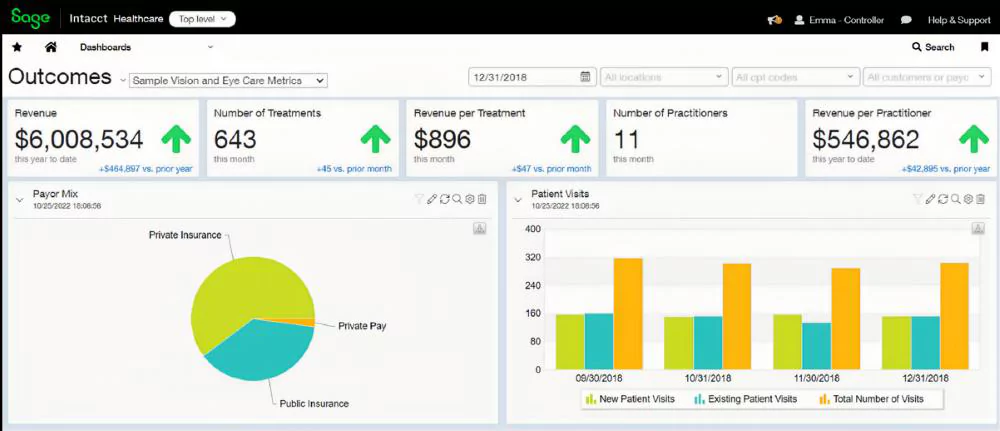
Sage Intacct is a cloud-native financial management platform widely adopted in healthcare, particularly among nonprofit providers, specialty practices, community health organizations, and multi-entity healthcare groups. The platform is designed to strengthen financial transparency, automate core accounting processes, and provide real-time reporting across complex organizational structures.
While Sage Intacct includes purchasing and basic inventory functionality, its primary strength lies in financial governance and multi-entity consolidation. Healthcare finance teams often implement the platform to improve oversight, standardize approvals, and maintain audit readiness in environments where financial control is a priority.
To enhance procurement governance, Sage Intacct offers Clinical eProcurement, which embeds catalog-based purchasing, approval workflows, and real-time budget visibility directly within the accounting environment. This capability helps organizations centralize purchasing activity while maintaining strong financial controls.
Sage Intacct is frequently chosen by healthcare organizations that prioritize financial oversight and structured procurement processes over advanced warehouse automation or enterprise-level supply chain orchestration. It can be particularly well suited for organizations with moderate operational complexity that seek to modernize purchasing and accounting within a finance-first ERP framework.
While multiple ERP platforms serve healthcare organizations, implementation success ultimately depends on strategic alignment and execution.
Find the right ERP for your healthcare supply chain needs
Selecting the right ERP solution depends on the size, complexity, and growth trajectory of your healthcare organization. Rand Group works with healthcare finance leaders to assess operational requirements and recommend the platform that best aligns with clinical, financial, and supply chain needs.
Healthcare ERP comparison for supply chain management
To help healthcare leaders evaluate their options, the following comparison outlines how leading ERP platforms support financial management, procurement, inventory control, and supply chain operations. While capabilities may vary based on configuration and selected modules, this overview highlights the relative strengths, scalability, and operational depth of each solution.
Healthcare technology company case study
Rand Group partnered with a leading U.S.–based healthcare technology organization to modernize its systems and eliminate manual bottlenecks that were hindering supply chain operations. The client’s outdated on-premise systems and processes limited real-time visibility, slowed reporting, and constrained vendor and inventory workflows. Rand Group implemented Microsoft Dynamics 365 Business Central along with Rand Group’s Supply Chain Accelerator app to:
- Streamline supply chain and vendor management processes, reducing manual effort and improving operational efficiency
- Improve inventory visibility and accelerate financial and operational reporting
- Provide a scalable, cloud-based platform capable of supporting growth and future initiatives
After the transformation, the healthcare technology organization gained faster access to accurate data, real-time insights across financial and supply chain functions, and streamlined workflows that helped the organization operate more efficiently and scale with confidence.
The future of healthcare supply chains
The future of healthcare supply chain management will be shaped by smarter forecasting, coordinated data environments, and greater operational transparency. AI-powered demand planning, real-time inventory tracking, and cloud-based ERP platforms are helping healthcare organizations anticipate shortages, manage risk proactively, and maintain operational continuity.
Rather than reacting to disruptions, leading organizations are investing in healthcare supply chain management software that supports predictive planning and cross-functional alignment. As complexity increases, resilient and data-driven supply chains will become a competitive and clinical necessity.